
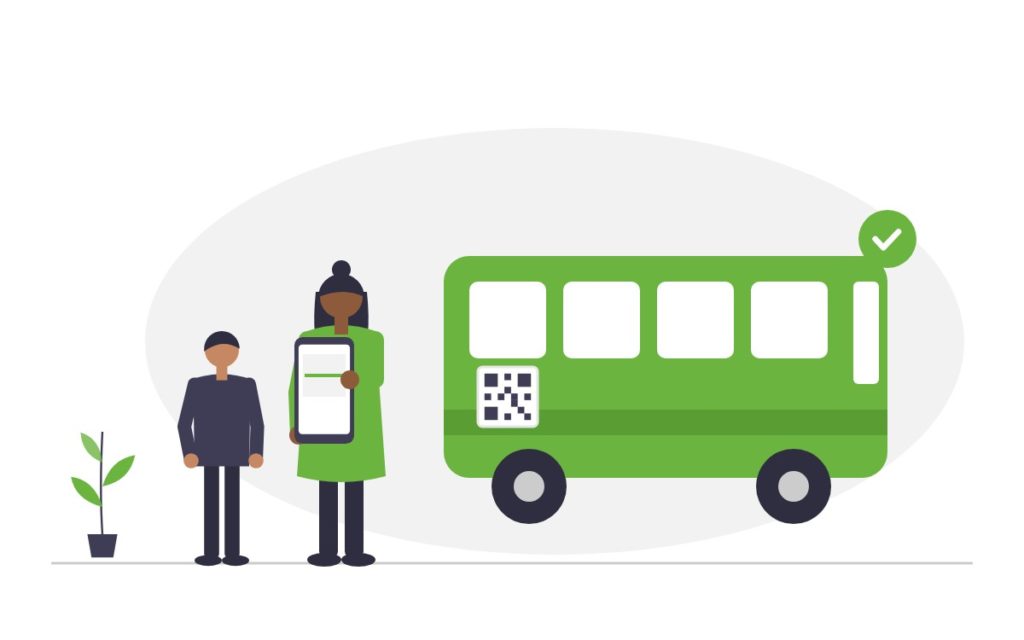
At a glance: A multi-branch school in Kolkata ran a mixed transport fleet — a limited number of owned buses alongside external car pools and vendor-managed buses — and needed reliable, end-to-end tracking of student movement without installing hardware on vehicles it didn’t own. Vawsum’s QR-based transport attendance answered it with zero hardware cost: students carry the QR code on their existing school ID card, and any bus assistant on any vehicle — owned or vendor-run — can scan it.
The setup
Most transport-tracking conversations start with a GPS budget. This school’s problem was that a GPS-first answer simply didn’t fit its fleet. The school owned a limited number of buses outright, but the majority of its daily transport ran through external car pools and smaller buses operated by independent vendors — vehicles the school didn’t own, couldn’t permanently modify, and couldn’t dictate maintenance terms for.
The school’s actual goal was simple to state and hard to solve with conventional hardware: know reliably that a child got picked up, got to school, got back on the bus, and got home — on every leg of the journey, on every kind of vehicle in the fleet, owned or not.
The problem
Hardware-based attendance devices don’t scale across a mixed, partly-outsourced fleet. Installing a fixed attendance machine on every vehicle is expensive at the best of times; installing it across owned buses, car pools and vendor buses multiplies that cost across a fleet the school doesn’t fully control.
External vendors weren’t willing to absorb the cost, and weren’t willing to accept the liability. Independent car pool and bus operators had no interest in paying for devices they hadn’t asked for, and were unwilling to let a school install permanent hardware on vehicles they were themselves responsible for maintaining. A vendor’s reluctance here isn’t unreasonable — the maintenance and liability now sit with equipment they don’t own and didn’t choose.
Whatever solution the school picked had to work identically across three different kinds of vehicle — owned buses, car pools, and vendor-managed buses — without asking any one category for something the others couldn’t also do. A solution that worked on owned buses but couldn’t be extended to vendor vehicles would have solved a fraction of the actual transport population.
No vehicle hardware, anywhere in the fleet
The attendance point lives on the student, not the vehicle
Zero hardware cost, zero vendor pushback
What changed
Vawsum’s QR-based transport attendance, part of the Transport Management System and Vawsum Secure+, was built around exactly this constraint: the attendance point lives on the student, not on the vehicle. No vehicle-side hardware means no vehicle-side cost and no vehicle-side liability question — the same QR code works whether the bus is school-owned or run by a vendor who has never heard of Vawsum.
- Unique QR codes were printed and affixed to the back of every student’s existing ID card — no new card, no separate device to carry, no re-issuing to families mid-year.
- From the next academic year, the same QR codes print natively on ID cards generated through the Vawsum ID card system, so the retrofit step becomes unnecessary going forward — new cards arrive QR-ready.
- The number of daily scan points is entirely configurable by the school — not a fixed choice between models, but a setting the school decides for itself. This school runs four: pickup from home, drop at school, boarding from school for the return leg, and drop at home — giving visibility on every individual leg of the journey rather than just a single boarding event. Other schools run two or three, depending on how granular they want visibility to be; the same system scales to whatever a school decides without any change to the underlying setup.
- Scanning supports a bulk mode, so a bus assistant can process a full vehicle of students quickly at a stop rather than scanning cards one at a time while a queue of students waits to board.
- Parents receive an instant push notification at every scan point, so a parent knows their child was accounted for at each stage of the commute, both ways.
- Comprehensive reports are available to the school administration, covering attendance by route, by vehicle and by student, for ongoing monitoring and record-keeping.
The result
The school achieved end-to-end visibility of student movement across its entire transport operation — owned buses, car pools and vendor vehicles alike — without a single hardware purchase and without asking a single vendor to absorb a cost or a liability they’d already refused. The same QR code that works on a school-owned bus works identically on a vendor’s car, because the attendance point was never the vehicle to begin with.
Parents get timely updates at every stage of the commute rather than a single end-of-trip confirmation, and the school’s oversight now extends uniformly across branches and across vehicle types that previously sat outside any consistent tracking at all. Because the solution scaled without needing vendor buy-in on cost or hardware, it scaled everywhere the school needed it to — including the parts of the fleet it doesn’t own.
FAQs
Does this require installing any hardware on the vehicles?
No. The attendance point is the student’s ID card, not the vehicle, so there is nothing to install, maintain or insure on any bus — owned or vendor-operated.
Can this work on vehicles the school doesn’t own, like vendor-run car pools?
Yes. Because the QR code lives on the student’s ID card and any device can scan it, the same system works identically on owned buses, car pools and vendor-managed vehicles, without requiring the vendor to install or maintain anything.
How many times a day is attendance scanned?
That’s entirely the school’s decision. This school runs four points — pickup from home, drop at school, boarding from school, and drop at home — for full visibility on every leg of the journey. Other schools run two, three, or whatever number suits their transport setup; the number of scan points is fully configurable rather than fixed.
Can staff scan a full busload of students quickly, or is it one at a time?
Scanning supports a bulk mode, so staff can process multiple students in quick succession at a stop rather than scanning each card individually.
Do parents get notified after every scan?
Yes. An instant push notification goes to parents at every attendance point, so a parent is kept informed across each stage of the commute rather than only at the end of the journey.
See related case studies: how one 8-branch school group cut its payroll cycle from a week to under a day, how a residential school in Siliguri turned leave policy into a configurable rules engine, how a reputed ICSE school ran 1,000+ annual admissions through one auditable pipeline, and how a Kolkata residential school made hostel attendance verifiable with photo-checked roll call four times a day, how a Bengali-medium school with zero computers went digital using nothing but phones — a path many schools across India are still on today, how a CBSE school in Siliguri fixed chronic late fee payment by linking admit card downloads to a fee-clearance cutoff, and how a West Bengal Board school in Burdwan district replaced informal cash and screenshot-based collection with a fully auditable, access-controlled fee system, and how a Jalpaiguri school rebuilt its annual ID card renewal around class-teacher photo capture and parent self-service updates, and how a Kolkata-area school with 100+ teachers replaced its daily substitute scramble with rule-based, auditable allocation.




Recent Comments